AI Agents Are the Mars Rovers of Knowledge -- Why Real-Time Data Beats a Frozen Snapshot
LLMs know what the world looked like months ago. AI agents go out and explore it right now. Here's why the difference matters, how MurmurCast's pipeline already works this way, and what our upcoming AI agent will change.
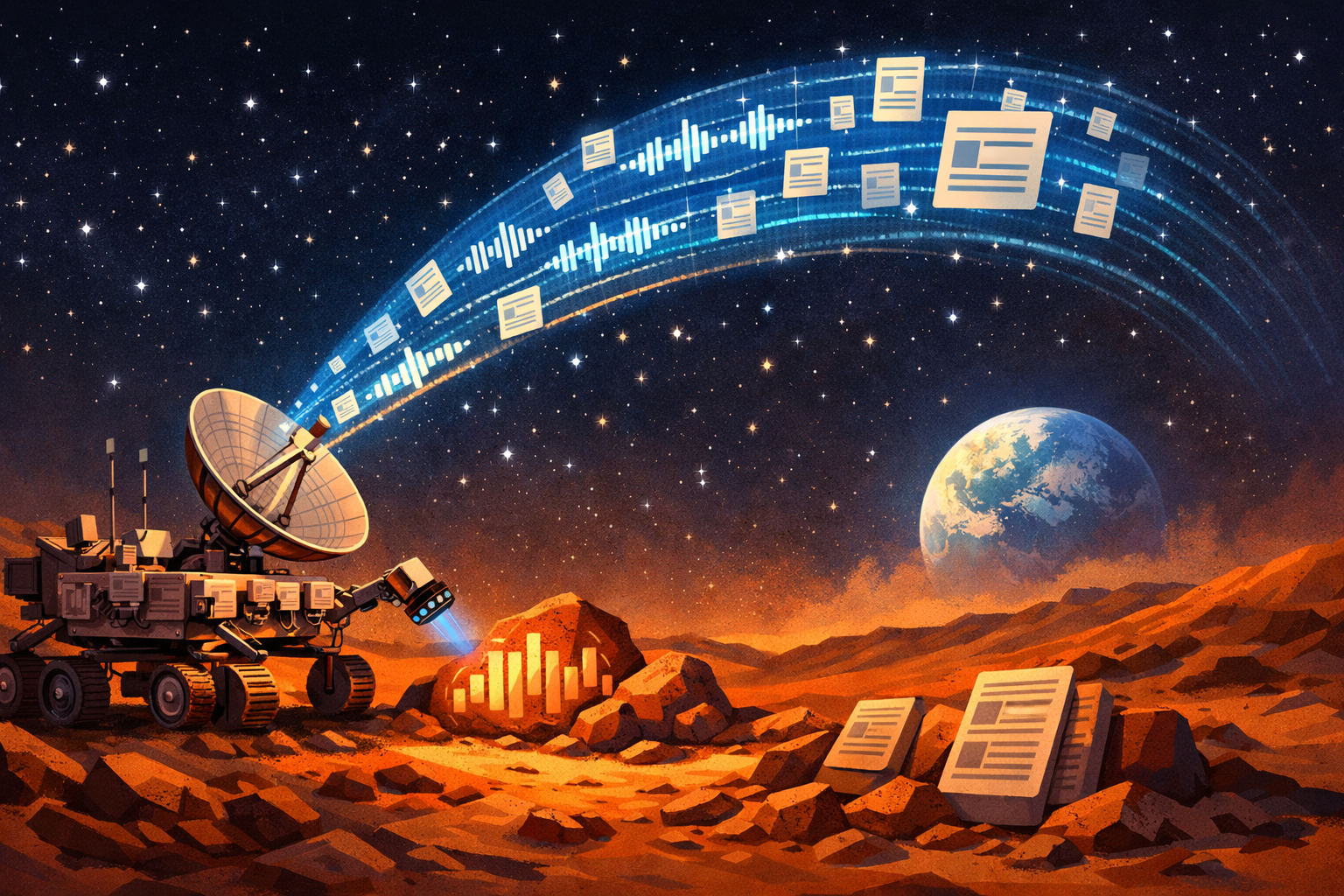
Ask ChatGPT about the podcast episode that dropped this morning. Ask Claude about the newsletter that hit your inbox an hour ago. Ask Gemini what happened on your favorite YouTube channel yesterday.
You will get nothing useful. Or worse -- you will get a confident, well-written answer that is completely made up.
This is the cold data problem. Large language models are trained on snapshots of the internet. Their knowledge is frozen at a cutoff date, and everything that happened after that date is a blind spot. The model does not know what it does not know. It will either tell you it cannot help or it will hallucinate something plausible.
AI agents solve this problem in a fundamentally different way. And the best analogy for understanding why comes from 225 million kilometers away.
The Mars Rover Problem
In the 1970s, NASA had a Mars problem. Orbital spacecraft could photograph the surface of Mars from above -- they could map terrain, track weather patterns, and identify interesting geological features. But photographs from orbit could not tell you what the rocks were made of. They could not measure soil chemistry. They could not drill beneath the surface to find what was hidden underneath.
To do real science on Mars, NASA needed something on the ground. Something that could navigate terrain autonomously, choose which rocks to examine, drill into them, run experiments, and send results back to Earth. Something that could make decisions in real-time because the 20-minute communication delay with Earth made remote control impractical.
That is what the Mars rovers do. They are not fully autonomous -- JPL scientists set high-level objectives and define safety boundaries. But within those constraints, the rovers navigate terrain, select targets, and run experiments without waiting for instructions from Earth. They combine human direction with on-the-ground autonomy, and that combination is what makes them effective at the frontier.
Large language models are the orbital photographs. They give you a high-level view of what the world looked like at a point in time. They are useful. They are impressive. But they cannot tell you what is happening on the ground right now.
AI agents are the rovers. You set the objectives -- which topics you care about, which sources you trust. The agent handles the on-the-ground work of retrieving, processing, and making sense of what it finds.
What Makes Data "Cold"
Every LLM has a knowledge cutoff -- the date after which it has no training data. For most models, this cutoff is weeks to months behind the present. Some models are refreshed more frequently than others, but none of them are real-time. They cannot be. Training a large language model takes weeks and costs millions of dollars. You do not retrain the model because a new podcast episode dropped.
This creates a specific category of failure:
-
Temporal blindness. The model literally does not know about events, content, or conversations that happened after its cutoff. A three-hour interview with a CEO announcing a major pivot last Tuesday? Does not exist in the model's world.
-
Stale context. Even for topics the model does know about, its information may be outdated. Markets move. Opinions evolve. A researcher who held one position six months ago may have published a paper reversing it last week.
-
Hallucinated currency. This is the dangerous one. When you ask an LLM about something recent, it sometimes generates an answer that sounds current but is fabricated. It stitches together plausible-sounding details from older data and presents them as fact. You get the confidence of a real answer without the substance.
For casual questions, this is a minor annoyance. For professionals who make decisions based on current information -- investors, researchers, journalists, executives -- cold data is a serious problem. The information you need most is exactly the information the model does not have.
The industry knows this. That is why Retrieval-Augmented Generation -- RAG -- has become the standard approach for grounding LLMs in current data. Tools like Perplexity, ChatGPT with web search, and Google's AI Overviews all use some form of RAG: when you ask a question, the system searches the web in real-time, retrieves relevant pages, and feeds them to the model alongside your question. This is a genuine improvement. It solves the knowledge cutoff problem for many use cases.
But RAG has a specific shape, and understanding its shape reveals what it cannot do.
Why Perplexity is not enough
Perplexity is genuinely good at what it does. If you have a specific question about a current event, it will search the web, find relevant pages, and synthesize an answer with citations. For many queries, that is exactly what you need. But there are four structural limitations that separate reactive search from agentic intelligence:
Reactive vs. proactive. Perplexity answers questions you already thought to ask. It requires you to know that something happened, formulate the right query, and go looking for the answer. An agent works in the opposite direction -- it monitors your sources continuously and surfaces information before you ask. Your daily brief arrives with insights you did not know existed. The most valuable information is often the thing you would not have thought to search for: the podcast guest who casually mentioned your competitor pivoting, the newsletter that covered a regulatory change you were not tracking. A search tool cannot find what you do not know to search for.
Your experts vs. the open web. When Perplexity searches the web, it decides which sources to trust on your behalf. Its algorithm picks the pages it considers most relevant and authoritative. You have no say in which voices it amplifies. An agent built on your curated subscriptions inverts this -- you chose these podcasters, these newsletter writers, these YouTube creators because you trust their judgment and expertise. The signal-to-noise ratio is fundamentally different when the source list is curated by you rather than by a search ranking algorithm. You are not asking "what does the internet say about this?" You are asking "what do the people I trust say about this?"
Audio and video native vs. text-web native. This is the limitation most people overlook. Perplexity searches web pages -- text documents, articles, blog posts. It cannot listen to a three-hour podcast interview, transcribe the conversation, and summarize the arguments made at the 47-minute mark. It cannot watch a YouTube deep-dive and extract the specific data points the creator presented. The highest-value expert knowledge is increasingly locked inside long-form audio and video that text-based search literally cannot reach. When a fund manager explains their thesis on a podcast, when a researcher walks through their findings in a conference talk, when a founder discusses their roadmap on a YouTube interview -- none of that is searchable by Perplexity because it was never written down. An agent that transcribes and processes these formats makes an entire layer of expert knowledge accessible that search tools cannot touch.
Longitudinal vs. point-in-time. Perplexity gives you a snapshot -- the state of the web at the moment you asked. It has no memory of what it found for you last week. It cannot tell you that a topic is trending because it appeared in one source last month and five sources this week. It cannot notice that the sentiment around a company shifted from positive to skeptical over the past two weeks across your subscriptions. An agent that accumulates knowledge over time builds a longitudinal view -- it sees patterns, trajectories, and shifts that a point-in-time search cannot detect. This is the difference between checking the temperature right now and having a weather station that tracks the climate.
RAG is a better camera on the same satellite. An agent is a rover on the ground.
What Makes an Agent "Hot"
An AI agent does not rely on what it was trained on. It goes out and gets the data -- not in response to a single query, but continuously, proactively, across formats that text-based search cannot reach.
The distinction is architectural, not cosmetic. An LLM generates text from patterns it learned during training. A RAG system adds a search step before generation. An AI agent goes further: it uses an LLM as one component in a larger system that includes continuous monitoring, multi-format retrieval, processing, and delivery. The LLM provides the intelligence -- the ability to read, understand, and summarize -- but the data it operates on is live, curated, and sourced from the channels you actually care about.
Here is what makes agent-retrieved data fundamentally different from training data:
It is sourced. Every piece of information comes from a specific, identifiable origin -- a YouTube video published at a specific time, a podcast episode with a specific RSS entry, a newsletter sent to a specific inbox. You can trace any claim back to its source. Hallucination risk drops dramatically because the agent is working from an actual document, not from statistical patterns. It can still misinterpret or over-compress -- no summarization is perfect -- but every output links to the original material so you can verify.
It is timely. The agent retrieves data when it is published, not when a training run happens to include it. The gap between "content exists in the world" and "you have a processed summary of it" shrinks from months to hours. To be clear -- hours is not real-time. For breaking news or market-moving events, you still need live feeds and alerts. But for the kind of knowledge that compounds -- expert analysis, in-depth interviews, research findings -- hours-old is orders of magnitude better than months-old.
It is complete. An LLM's training data is a sample of the internet. Huge amounts of content are never included -- paywalled newsletters, audio-only podcasts, videos without transcripts. An agent can access and process these sources directly because it does not depend on a web crawl.
It is structured. Raw content on the internet is messy. A two-hour podcast episode is a wall of unstructured speech. An agent can transcribe, parse, categorize, and format that content into something you can actually use in minutes.
How MurmurCast Already Works This Way
MurmurCast's existing pipeline is already an agent-style system, even if we have not always described it that way. Here is what happens every day:
-
Monitoring. Our system continuously polls RSS feeds, YouTube channels, and newsletter inboxes for new content. When something new appears, it enters the processing queue. For podcasts, we also support WebSub -- a protocol where the feed itself notifies us the moment a new episode is published, eliminating polling delay entirely.
-
Retrieval. For YouTube videos, we first attempt to pull existing captions -- auto-generated or manual. If captions are not available, we download the audio. For podcasts, we download the audio file from the RSS enclosure. For newsletters, we capture the email content directly. The agent goes to the source.
-
Transcription. Audio content goes through Whisper, producing a full text transcript. This is the step that makes audio and video content legible to an LLM. Most of the world's interesting conversations happen in formats that are invisible to text-trained models. Transcription bridges that gap.
-
Summarization. The transcript -- sometimes 20,000 words or more -- is processed by Claude, which extracts key takeaways, arguments, data points, and conclusions. The output is a structured summary that takes two minutes to read instead of two hours to listen to.
-
Delivery. Every morning, users receive a daily email digest containing summaries of everything that was published across their subscriptions in the last 24 hours. The information comes to you -- you do not go looking for it.
Every summary in your daily brief is grounded in content that was published hours ago, not months ago. Every claim is traceable to a specific episode, video, or newsletter. The system is not generating from memory -- it is generating from source material it just retrieved, which dramatically reduces the risk of fabrication.
An important caveat: sourced does not mean infallible. A podcast guest can state something incorrect. A newsletter can report a rumor as fact. The agent will faithfully summarize what was said, and the summary itself may lose nuance in compression. The difference from a pure LLM is that you can always check -- every summary links back to the original content, so verification is one click away instead of a research project.
This is the rover model. MurmurCast does not know things about the world the way an LLM "knows" things. It goes out, collects samples, analyzes them, and reports back -- and it tells you exactly where each sample came from.
It works while you sleep
This is the part that is easy to overlook because it sounds simple, but it changes your relationship with information entirely.
A podcast episode drops at 11pm. A newsletter lands at 2am from a writer in a different time zone. A YouTube creator publishes a deep-dive at 6am before you wake up. With Perplexity or ChatGPT, none of this matters until you sit down, remember to check, and type the right query. If you do not ask, you do not know. The burden is on you to stay on top of everything, and "everything" keeps publishing whether you are awake or not.
MurmurCast's pipeline does not wait for you. While you sleep, the system is polling feeds, detecting new content, downloading audio, transcribing speech, and generating summaries. By the time you open your email in the morning, the work is done. Every episode that dropped overnight, every newsletter that arrived at 3am, every video that was published while you were away from your desk -- all of it is processed, summarized, and sitting in your inbox as a single daily brief.
This is not a convenience feature. It is an architectural difference. Perplexity is a tool you operate -- you drive it, you steer it, you decide when to use it. MurmurCast is an agent that operates on your behalf -- you set the objectives once, and it runs continuously. The Mars rovers do not wait for a scientist at JPL to wake up and tell them to start working each morning. They have their objectives, and they execute while the team sleeps. You review the results when you are ready.
The practical effect is that staying informed stops being a task on your to-do list. You do not block out time to "catch up on podcasts" or "check what newsletters came in." The agent already did that. Your job is to read the brief, decide what deserves deeper attention, and move on with your day. The information found you -- you did not have to go find it.
There is a limitation to this approach, though, and it is worth being honest about it: every source MurmurCast processes today is a structured source. RSS feeds have predictable formats. YouTube channels have APIs. Newsletter inboxes receive emails with parseable HTML. The pipeline knows exactly where to look and what shape the data will be in when it arrives.
This works extremely well for the content formats it covers. But the world's knowledge does not live exclusively in RSS feeds and YouTube uploads. It lives in conference talks uploaded to Vimeo, in Twitter threads, in Discord conversations, in court filings, in earnings call transcripts, in regulatory filings, in academic preprints, in Reddit AMAs, in live streams, in Telegram channels, in slide decks shared on LinkedIn. These are unstructured sources -- they do not come with clean APIs, predictable formats, or reliable update signals. They require an agent that can navigate unfamiliar terrain, not just follow a pre-mapped route.
This is where the rover analogy becomes most precise. The Mars rovers operate within boundaries set by their human teams, but within those boundaries they make autonomous navigation decisions, respond to unexpected terrain, and choose which targets to investigate based on what they encounter. A pipeline follows a map. An agent explores within the boundaries you set -- and finds things along the way that you would not have known to look for.
What Is Coming: The MurmurCast Agent
Our current pipeline is powerful, but it has two constraints. First, it is linear -- content comes in, gets processed, and gets delivered. It does not think about what it found. It does not connect dots across sources. It does not notice that three different podcasts this week discussed the same emerging trend from different angles. Second, it only speaks the languages of structured data -- RSS, APIs, inboxes. It cannot venture beyond those boundaries.
Both of those constraints are about to change.
We are building a MurmurCast AI agent that operates on top of our existing ingestion pipeline. It does not replace the pipeline -- it extends it in two directions: deeper intelligence over structured sources, and outward reach into unstructured ones.
Deeper intelligence over your existing sources
Cross-source synthesis. The agent will identify when multiple sources across your subscriptions are discussing the same topic, person, company, or idea -- even when they use different terminology. If a VC discusses a startup on a podcast, a newsletter covers their funding round, and a YouTube analyst reviews their product, the agent will connect those threads and surface the pattern. You will see the full picture instead of three disconnected fragments.
Trend detection. By analyzing content across your subscriptions over time, the agent will identify emerging topics -- subjects that are suddenly appearing across multiple sources after being absent or rare. These are early signals. The kind of insight that is impossible to get from an LLM because it requires comparing what is happening now to what was happening last week, using real-time data in both cases.
Personalized briefing. The agent will learn what matters to you -- not just which sources you subscribe to, but which topics you engage with, which summaries you click through, which episodes you bookmark. Over time, your daily brief will become increasingly focused on the information that is actually relevant to your work and interests.
Ask your sources. This is the feature we are most excited about. You will be able to ask natural language questions -- "What has anyone in my subscriptions said about the new EU AI regulation?" -- and get answers grounded entirely in content from your sources. Not from an LLM's training data. Not from a web search. From the specific experts, journalists, and creators you chose to follow, using their most recent content. Every answer will include citations linking back to the exact episode, timestamp, or article.
Outward reach into unstructured sources
This is the part that transforms MurmurCast from a pipeline into a true agent.
Today, if a critical discussion about your industry happens in a Twitter thread, a regulatory filing, or a conference talk on an obscure video platform, MurmurCast cannot see it. Those sources do not have RSS feeds. They do not push notifications. They live outside the structured data ecosystem.
This is the hardest problem on our roadmap, and we want to be straightforward about it. Unstructured sources are unstructured for a reason -- they have authentication barriers, rate limits, inconsistent formats, and legal constraints. We are not going to solve all of this on day one. But the direction is clear, and here is what we are building toward:
Autonomous source discovery. When the agent detects a trending topic across your structured sources -- say, multiple podcasts mentioning a new regulation or a startup -- it will be able to follow that thread outward. It can locate the original regulatory filing, find the company's public financial disclosures, pull the relevant academic paper, or surface the social media thread where the news first broke. The agent does not wait for you to subscribe to these sources. It finds them because the conversation led there. Early versions will focus on publicly accessible sources -- government filings, open-access papers, public company disclosures -- where the legal and technical barriers are lowest.
Non-traditional format ingestion. Conference talks on Vimeo. Earnings call recordings on investor relations pages. Panel discussions uploaded to niche platforms. PDF whitepapers linked from blog posts. These formats are invisible to most AI tools because they do not fit neatly into podcast or YouTube categories. An agent can recognize what it is looking at, choose the right extraction method -- audio transcription, PDF parsing, web scraping -- and process it into the same structured format as everything else in your brief.
Following the citation trail. When a podcast guest references a study, the agent can track down that study. When a newsletter links to a primary source, the agent can retrieve and summarize the primary source alongside the commentary. This is how human researchers work -- they do not stop at the first thing they read. They follow references, verify claims, and build a complete picture. The agent does the same thing, autonomously, at scale.
The difference between a pipeline and an agent is the difference between a fixed telescope and a rover. The telescope sees what it is pointed at. The rover goes where the interesting findings are -- including places you did not know to look.
The difference between asking an LLM a question and asking the MurmurCast agent the same question is the difference between consulting a textbook and consulting a network of live researchers. The textbook was accurate when it was printed. The researchers know what happened today -- and they went and checked the primary sources.
From File Systems to Tokens to Agents
Jensen Huang made a striking observation at CES 2025 that captured a shift the entire industry was already feeling: the fundamental unit of computing is moving from files to tokens. His point was broader -- about AI factories and how datacenters will process tokens the way traditional computers process files -- but the core insight resonates beyond infrastructure. For decades, computing was built on retrieval. You stored knowledge in files -- documents, databases, spreadsheets -- and the computer's job was to find and return the right file when you asked for it. Search engines scaled this model to the internet. Google's original insight was that the entire web was a file system, and the hard problem was ranking which files to show you.
Then LLMs changed the paradigm. Instead of retrieving a file that contains the answer, the model generates the answer. You do not search for a document about how monetary policy affects housing markets -- you ask the model, and it synthesizes an answer from everything it absorbed during training. Tokens replaced files. Generation replaced retrieval. This is what Huang was describing: a fundamental shift in how computers relate to knowledge.
But here is what that framing misses: generation without grounding is a dead end for anything that requires current, accurate information.
A generative model can explain how monetary policy works in general. It cannot tell you what the Fed chair said in yesterday's press conference. It can describe the landscape of AI startups in a sector. It cannot tell you which one just raised a Series B this morning. The model generates from what it learned. It does not know what it has not seen.
This is where agents complete the picture. The progression is not file systems to tokens. It is file systems to tokens to agents that go out, retrieve live information, and then use tokens to reason about it.
The file system era: Computer finds and returns a stored document. Fast, verifiable, but you need to know what to search for, and the document has to exist.
The generative era: Model synthesizes an answer from training data. Flexible, conversational, but frozen in time and unverifiable. The model sounds confident whether it is right or wrong.
The agentic era: Agent retrieves current data from live sources, then uses a model to reason about it. You get the flexibility of generation with the groundedness of retrieval -- and a timestamp on every claim.
MurmurCast's agent is one example of this third era in action. But the pattern is much larger than any single product.
The first wave of AI was about models -- bigger models, trained on more data, capable of more impressive generation. That wave produced extraordinary tools. But it also produced a specific failure mode: models that sound authoritative about things they do not actually know.
The second wave is about agents -- systems that use models as reasoning engines but ground them in real-time, verified, sourced data. The model provides the intelligence. The agent provides the truth.
This is not a theoretical distinction. It is the difference between:
- "Based on my training data, here is what I know about this topic..." (cold)
- "Based on what these 12 sources published this week, here is what is happening..." (hot)
The first answer might be accurate. It might also be outdated or fabricated. You have no way to verify without doing the research yourself -- which defeats the purpose.
The second answer is grounded. Every claim has a source. Every source has a timestamp. You can verify any detail by going to the original content. The agent did the research for you, and it showed its work.
Huang was right that tokens replaced the file system. But tokens alone are not enough. The next step is agents that use tokens to think -- and retrieval to stay honest.
Why This Matters Now
The volume of valuable content being published every day -- in podcasts, on YouTube, in newsletters, on Substack, in webinars -- is growing faster than any person can consume. This is not the usual "information overload" complaint. It is a structural problem: the most important insights are increasingly locked inside long-form audio and video formats that are invisible to traditional text-based tools, including LLMs.
An AI agent that can monitor these sources in real-time, process them into structured knowledge, and surface patterns across them is not a nice-to-have. For anyone whose work depends on staying current -- and that is most knowledge workers -- it is becoming essential.
The Mars rover does not replace orbital photography. It does something orbital photography cannot do. It operates at the frontier, in real-time, on the ground, with the ability to investigate what it finds.
That is what AI agents do for knowledge. And that is what MurmurCast is building.
MurmurCast monitors your YouTube channels, podcasts, and newsletters, transcribes and summarizes new content with Whisper and Claude, and delivers it as a daily email digest. Our upcoming AI agent will add cross-source synthesis, trend detection, and the ability to ask questions across everything your sources have published. Sign up for early access.